Lei Yue Mun – Past Industries
Before becoming a seafood paradise, Lei Yue Mun was well-known for its stone quarrying and ceramic production industries.
Stone Quarrying
As early as the 18th century, a group of Hakka stonemasons started settling in Lei Yue Mun Village. Since the 19th century, Lei Yue Mun, Ngau Tau Kok, Sai Cho Wan, and Cha Kwo Ling where possessed high-quality granite were collectively known as the "Four Hills." Many "Shek Tong" (i.e. stone quarrying company in Hakka dialect) emerged in the area, extracting stone for local and Guangdong coastal construction projects. The Sacred Heart Cathedral in Guangzhou completed in the 14th year of the Guangxu Reign of the Qing Dynasty (1888), for example, was built with granite quarried from the "Four Hills."
During the Qing Dynasty, the Qing government appointed one person from each hill as a representative who was known as “Four Hill Headmen” to oversee local affairs and collect taxes from the government-approved quarries. Although they were not government officials, they were allowed to wear official attire and were accompanied by ceremonial guards holding plaques with the words "Silence and Avoidance" and sounded gongs to clear the way. The government officials responsible for tax collection from the government-approved quarries would pay them a visit upon taking office. It demonstrated the special status of the “Four Hill Headmen”.
After the lease of the New Territories in 1898, the British re-registered the land in Lei Yue Mun Village, and gradually closed the government-approved quarries until 1904, when the government gazetted the operation of Lei Yue Mun Quarry. Various quarries were granted licenses to resume operations and the stone quarrying industry became the main industry in Lei Yue Mun by the 1960s. However, in 1967, due to social unrest, the government implemented explosives control and did not renew the permit of small quarries, including Lei Yue Mun Quarry, leading to closure of business. This marked the end of the quarrying industry with over a hundred years of history in Lei Yue Mun. Today, some remaining structures of Lei Yue Mun Quarry such as piers, stone houses, stone walls and concrete buildings are retained and were accorded by the Antiquities Advisory Board as a Grade 3 historic building in 2015.
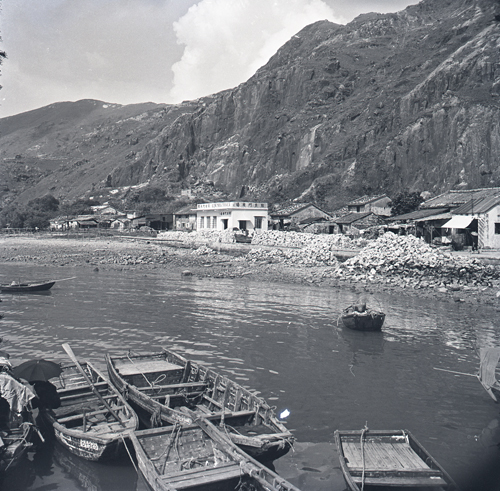 Early office, nearby houses, and barber shop at the Lei Yue Mun Quarry in the 1950s
(Photo source: University of Hong Kong Library)
(Photo source: University of Hong Kong Library)
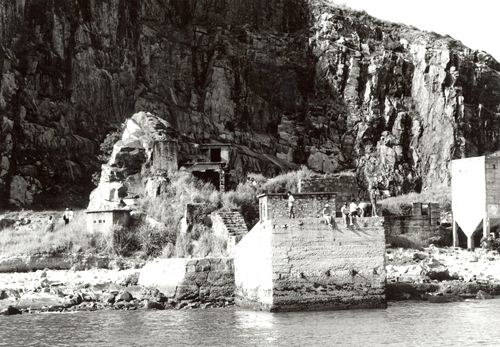 Old buildings of the Lei Yue Mun Quarry in 1993
(Photo source: University of Hong Kong Library)
(Photo source: University of Hong Kong Library)
Ceramic Industry
The ceramic production used to be another major industry in Lei Yue Mun. From the 1950s to the 1980s, the Majestic Chemical Art Craft Manufacture (also known as “Doll Factory”) was established on the hill behind the former Hoi Bun School. It mainly used Jingdezhen craftsmanship technique to produce ceramics imitating the Han and Tang dynasties ceramics handicrafts. The ceramics handicrafts were not only supplied to the local market but also exported to other countries such as Japan, Europe and the United States. In fact, they were even used as props in costume movies. Interestingly, before establishing the ceramics factory, the founder honed his skills by creating clay sculptures in Haw Par Mansion from 1953 to 1954. Haw Par Mansion was accorded by the Antiquities Advisory Board as a Grade 1 historic building in 2009. In the 1990s, Majestic Chemical Art Craft Manufacture closed down due to the inability to compete with ceramics from the Mainland and a decline in customer demand.
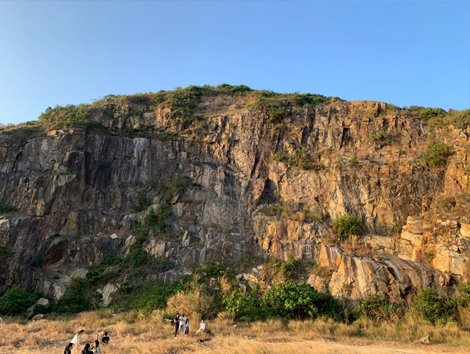 Old Lei Yue Mun Quarry
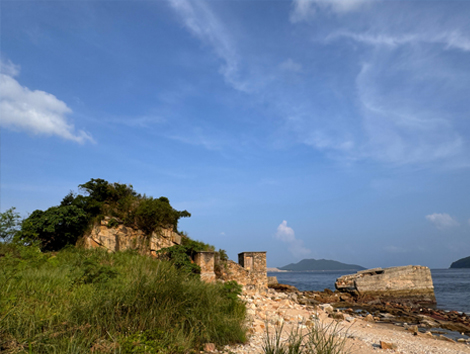 Old Lei Yue Mun Quarry